What Did the Supreme Court Do Before Judicial Review
On February 24, 1803, Chief Justice John Marshall issued the Supreme Court's decision in Marbury v. Madison, establishing the constitutional and philosophical principles behind the high court's ability of judicial review.
 The dramatic tale begins with the presidential election of 1800, in which President John Adams, a Federalist, lost reelection to Thomas Jefferson, a Democratic-Republican. Congress also changed hands, with the Autonomous-Republicans achieving majorities in both chambers.
Adams and the Federalists could run into the writing on the wall: the party's power had been limited to the judicial branch. In a bid to strengthen Federalist ability, President Adams appointed Secretary of State John Marshall to be Principal Justice of the Usa. The Federalists, with weeks remaining in the lame-duck session, passed a new Judiciary Act—the "Circuit Court Human action"—which expanded the jurisdiction of the circuit courts and created six new circuits with 16 new judicial seats. (The police force too eliminated excursion duty for Supreme Court justices, and provided for easier removal of litigation from state to federal courtroom.)
To fill the newly expanded judiciary, on March i, 1801, three days before Jefferson's inauguration, Adams stayed upwards late into the night signing commissions for the new judges, including the 42 new Justices of the Peace. The "midnight appointments," as they came to be known, were as well notarized by Marshall, notwithstanding performing his secretarial duties. But the rush of presidential transition led to the administration's failure to deliver several of those commissions, including that owed to William Marbury, who had been named a justice of the peace for the District of Columbia. On March 4, upon assuming the function of the presidency, Jefferson ordered Secretary of Country James Madison not to deliver the commissions.
Marbury's lost commission became a test case for the ousted Federalists who were outraged over the Democratic-Republican Congress'due south repeal of the Judiciary Human activity of 1801 and the passing of a replacement human activity in 1802, and who were hoping to test its constitutionality equally presently as possible. Before the Supreme Court considered the instance in February, Congress held a viciously partisan fence over the constitutionality of the Repeal Act, with Republicans claiming that the people were the concluding judges of the constitutionality of acts of Congress. Marbury, with representation from Adams' Attorney General Charles Lee, demanded a writ of mandamus from the Supreme Court to obtain his commission.
In M arbury five. Madison, the Courtroom was asked to reply three questions. Did Marbury take a correct to his commission? If he had such a correct, and the right was violated, did the law provide a remedy? And if the law provided a remedy, was the proper remedy a direct social club from the Supreme Court?
Writing for the Court in 1803, Marshall answered the first 2 questions resoundingly in the affirmative. Marbury's committee had been signed past the President and sealed by the Secretarial assistant of State, he noted, establishing an appointment that could not be revoked by a new executive. Failure to deliver the commission thus violated Marbury's legal right to the function.
Marshall also ruled that Marbury was indeed entitled to a legal remedy for his injury. Citing the cracking William Blackstone's Commentaries, the Chief Justice alleged "a full general and indisputable rule" that, where a legal correct is established, a legal remedy exists for a violation of that right.
It was in the 3rd part of the stance that presented a dilemma: If Marshall decided to grant the remedy and order delivery of the commissions, he risked merely being ignored by his rivals, thereby exposing the young Supreme Court as powerless to enforce its decisions, and damaging its future legitimacy. Just siding with Madison would have been seen equally caving to political pressure level—an equally damaging outcome, especially to Marshall who valued the Court as a nonpartisan establishment. The ultimate resolution is seen by many scholars equally a fine balancing of these interests: Marshall ruled that the Supreme Court could non social club delivery of the commissions, because the police establishing such a power was unconstitutional itself.
That police force, Section 13 of the Judiciary Act of 1789, said the Court had "original jurisdiction" in a example like Marbury—in other words, Marbury was able to bring his lawsuit directly to the Supreme Courtroom instead of first going through lower courts. Citing Article III, Section ii of the Constitution, Marshall pointed out that the Supreme Courtroom was given original jurisdiction only in cases "affecting Ambassadors, other public Ministers and Consuls" or in cases "in which a State shall be Party." Had the Founders intended to empower Congress to assign original jurisdiction, Marshall reasoned, they would not have enumerated those types of cases. Congress, therefore, was exerting power it did non accept.
This was an exercise of judicial review, the power to review the constitutionality of legislation. To be certain, Marshall did not invent judicial review—several state courts had already exercised judicial review, and delegates to the Constitutional Convention and ratifying debates spoke explicitly about such power being given to the federal courts. The Courtroom itself in the 1796 case of Hylton v. United States reviewed and upheld an act of Congress as constitutional—with Alexander Hamilton arguing for the validity of the revenue enhancement in question. And in Ware five. Hylton, the Supreme Court struck down a Virginia creditor law in conflict with the Treaty of Paris based on federal supremacy.
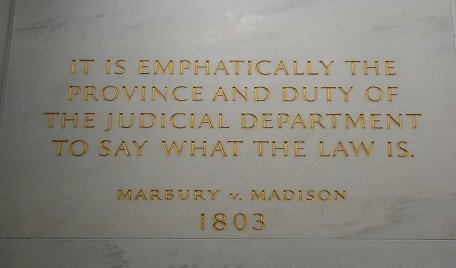
Still, the legendary Chief Justice applied judicial review firmly and artfully to the nation's highest court. "It is emphatically the duty of the Judicial Department," he wrote, "to say what the law is." Until Marbury, judicial review was non widely accustomed in cases of hundred-to-one unconstitutionality and was not an aspect of ordinary judicial activity, and its telescopic was more than modest. And while Marbury was not a specially controversial decision in 1803, it has remained the source of scholarly debate.
In the short run, Jefferson and the Democratic-Republicans got what they wanted: Marbury and the other "midnight appointments" were denied commissions. But in the long run, Marshall got what he wanted: A independent Supreme Court with the ability of judicial review. As historian Gordon Wood eloquently put it, Marshall's greatest accomplishment was not invented judicial review, but "maintaining the Courtroom's existence and asserting its independence in a hostile Republican climate."
For more reading on the contend between scholars over the meaning of Marbury and its implication for judicial review and judicial supremacy, consider the following:
Bruce Ackerman, Failure of the Founding Fathers: Jefferson, Marshall, and the Rise of Presidential Commonwealth (Harvard University Press 2005)
Albert Beveridge, The Life of John Marshall (1919)
Edward S. Corwin, John Marshall and the Constitution: A Relate of the Supreme Court (1977)
Mark A. Graber, "Passive-Aggressive Virtues: Cohens v. Virginia and the Problematic Establishment of Judicial Power," 12 Const. Comm. 68, https://conservancy.umn.edu/bitstream/handle/11299/167160/12_01_Graber.pdf?sequence=1&isAllowed=y
Charles Hobson, The Great Chief Justice: John Marshall and the Dominion of Law (1996)
Michael J. Klarman, "How Great Were the 'Smashing' Marshall Court Decisions?" Va. L. Rev. (2001), https://papers.ssrn.com/sol3/papers.cfm?abstract_id=270081
Larry Kramer, "Marbury and the Retreat from Judicial Supremacy," 20 Const. Comm. 205 (2003), https://salvation.umn.edu/bitstream/handle/11299/183156/20_02_Kramer.pdf
Leonard W. Levy, Original Intent and the Framers Constitution (2000)
Jed Handelsman Shugerman, "Marbury and Judicial Deference: The Shadow of Whittington v. Polk and Maryland Judiciary Battle," 5 U. Pa. J. Const. L. 58 (2002), https://scholarship.law.upenn.edu/jcl/vol5/iss1/3/
William W. Van Alstyne, "A Critical Guide to Marbury 5. Madison, 18 Duke Fifty. J. 1-47 (1969), https://scholarship.law.duke.edu/faculty_scholarship/544/
Louise Weinberg, "Marbury v. Madison: A Bicentennial Symposium," 89 Va. L. Rev. 1235 (2003), https://law.utexas.edu/faculty/uploads/publication_files/ourmarburypub.pdf
Nicholas Mosvick is a Senior Fellow for Constitutional Content at the National Constitution Center.
Source: https://constitutioncenter.org/blog/marbury-v-madison-and-the-independent-supreme-court
0 Response to "What Did the Supreme Court Do Before Judicial Review"
Post a Comment